
Ultra Low Latency Video Streaming Technology
Encrypted reliable live video streaming technology
Ultra Low Latency Video Streaming Technology
The Zao technology can live stream video, with a return remote control, from a remote location with an unmatched glass-to-glass latency of only 0,04s (40ms) over 5G, and 0,065s (65ms) over 4G.
The Zao-X is a hardware transmitter for traditional broadcast and public safety events, and the software based Zao-SDK for Jetson, is an OEM product for remote teleoperations, tele-driving, drone, and robotic control. Soliton uniquely enables secure video and control signals transmission in practically real time.
The importance of Ultra Low Latency is explained in this Q&A blog.
The technology uses a H.265 HEVC encoder for a variety of video contribution scenarios.
The Zao solutions can transmit a fully encrypted live video stream, and simultaneously a return path is created for control signals for remote control purposes. The Zao X hardware can off-the-shelf remotely operate a broadcast PTZ camera or a drone gimbal. The Zao SDK can be utilized as an OEM product by developers for remote control applications such as teleoperations.
The technology can live stream reliably over multiple bonded 4G and 5G SIM cards from different network providers, while LAN and Wi-Fi are also supported.
At the receiving end, a hosted or on-premise decoder will provide a video output with interfaces for control. End to end latency starts at a remarkable 0,04s.
The technology uses a H.265 HEVC encoder for a variety of video contribution scenarios.
The Zao solutions can transmit a fully encrypted live video stream, and simultaneously a return path is created for control signals for remote control purposes. The Zao X hardware can off-the-shelf remotely operate a broadcast PTZ camera or a drone gimbal. The Zao SDK can be utilized as an OEM product by developers for remote control applications such as teleoperations.
The technology can live stream reliably over multiple bonded 4G and 5G SIM cards from different network providers, while LAN and Wi-Fi are also supported.
At the receiving end, a hosted or on-premise decoder will provide a video output with interfaces for control. End to end latency starts at a remarkable 0,04s.
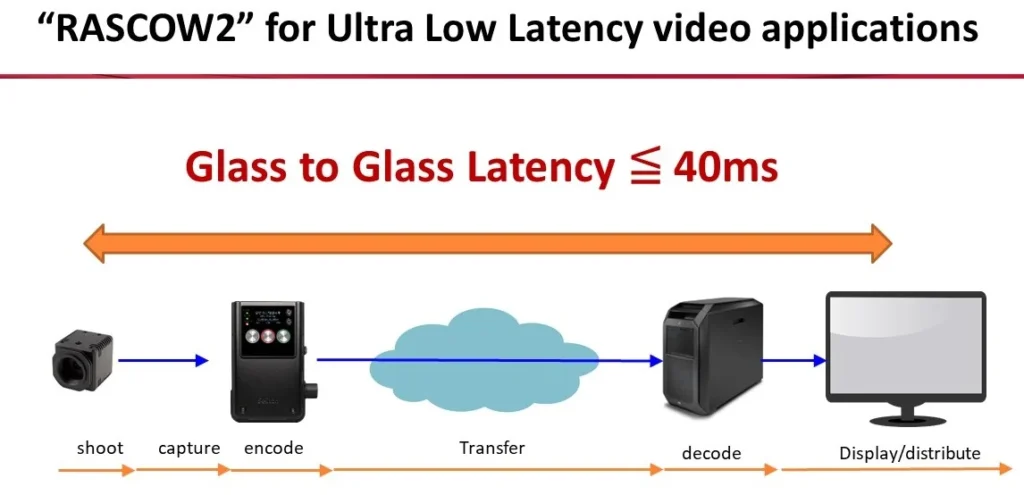
Shoot
The period from when the light enters the lens of the camera until video data is on the output of the SDI/HDMI terminal on the camera
Capture
The period from capturing video data from SDI/HDMI and performing color space conversion until it is input to the encoder
Encode
The encoding (compression) time
Transfer
The period in which compressed data is extracted from the encoder and divided into communication packets for multilink transmission/reception. Includes time for error correction and packet sorting between each connection
Transfer
The period in which compressed data is extracted from the encoder and divided into communication packets for multilink transmission/reception. Includes time for error correction and packet sorting between each connection
Decode
The decoding (uncompressing) time and creating standard streaming formats such as RTSP (IP) or SDI (baseband)
Display
The period from the decoding reciever output of the receiver to display the video on monitor (monitor-dependent part)
Functions/Features of Ultra Low Latency Technology
Very short delay / RASCOW2
Ultra Low Latency
In order to solve the delay problem that occurs during simple transmission, Soliton developed RASCOW2, which is Soliton’s streaming protocol for high reliability and ultra low latency. Standing for Real-time Auto Speed Control based On Waterway-model, RASCOW2 is Soliton second generation of live streaming ensuring the encoding procedure is ultra fast, while controlling all transmission effectively. This feature succeeded in significantly reducing the delay associated with compression.
Remote Control Function
Remote driving or remote operation
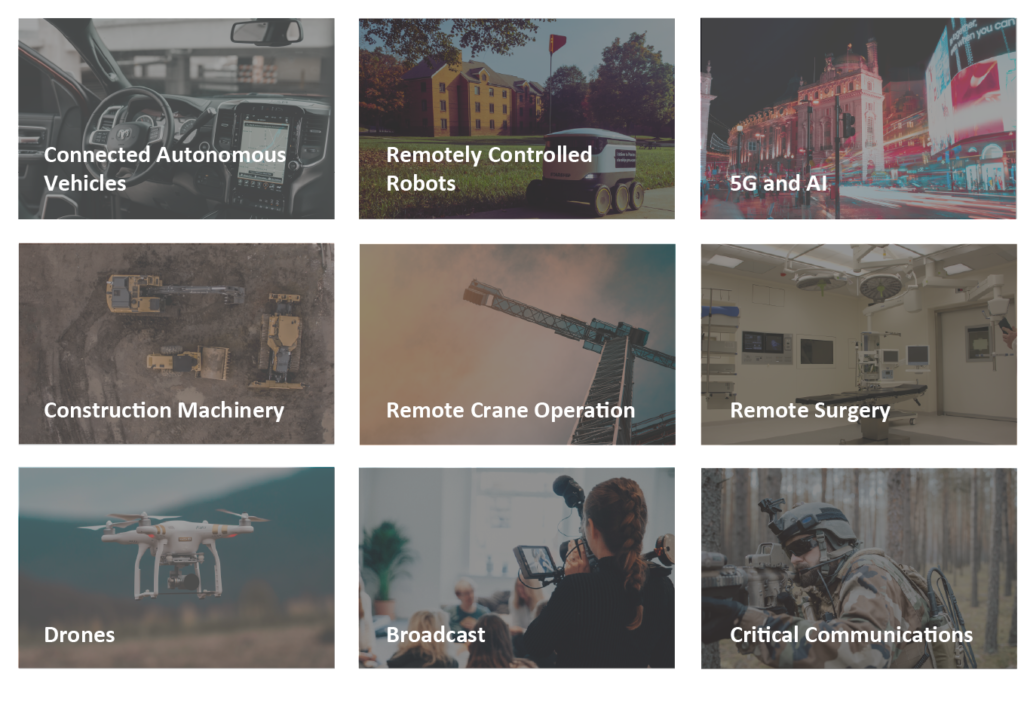
With almost zero latency, it is now possible to remotely control a car, construction equipment, drone, robot, or other remote device either via a Zao X or utilizing the Zao-SDK. Until now, the delay on live control transmission systems were too long, and it was difficult to perform remote operations safely with a live video stream. With ultra-low latency Zao solutions, it is possible to control machinery effectively with a live video stream viewing in almost real time from a remote location.
Stable and high speed
Multilink Bonding
Mobile networks of different cellular carriers can be bonded into one network to significantly increase bandwidth and stabilize the communication speed.
High compression
H.265/HEVC
Equipped with a highly efficient HEVC/H.265 hardware encoder, when compared to a traditional H.264 codec, it can transmit video with almost twice more efficiency.
Configuration
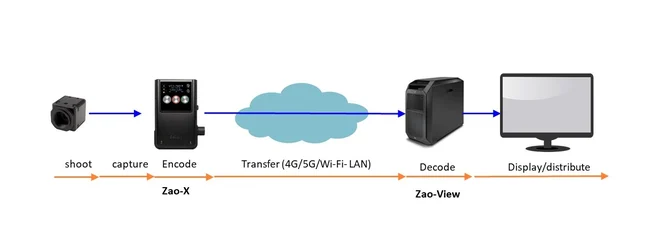
Basic configuration (Zao-X)
Connect the video camera to the transmitter and stream the video directly to the receiver via mobile networks or wired LAN.
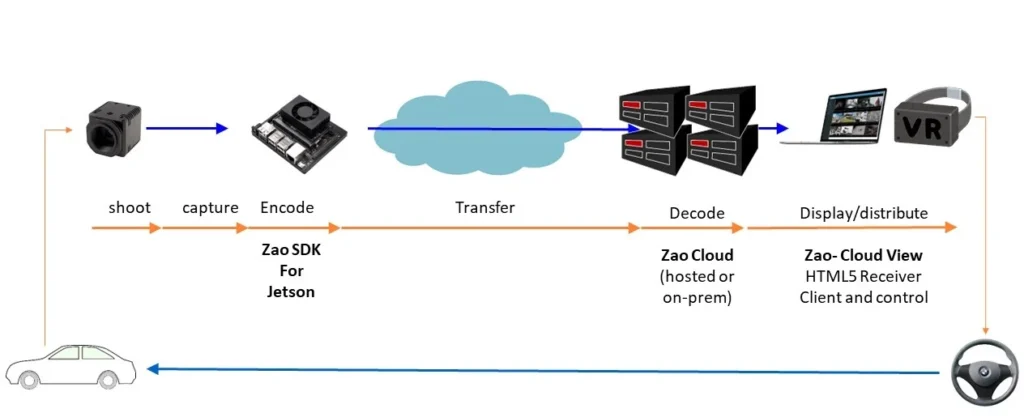
Remote control configuration (SDK)
Whether you are looking for priority or customized support, or looking at Mailzen as part of a bigger project, Soliton Systems can work with you in a consultancy capacity.
Ultra Low Latency Video Streaming FAQ's
What is ultra low latency?
Ultra Low Latency Video streaming is a glass-to-glass latency of less than 100ms (0.1sec) from camera to a remote screen. This includes the network connection which could be fiber, Wi-Fi, or cellular which could be either public 4G or 5G.
What is the lowest latency for video streaming?
Lowest latency is the combination of the camera latency, encoding latency, network latency, decoding and any display processing. Typically over 5G this could be as low as 35ms over the end-to-end workflow depending on the technology utilized.
Do you have real examples of ultra low latency for live streaming?
The lowest latency for video contribution from a live camera to the studio, as in the case of a live news report, can be as low as 65ms over 4G using Soliton Zao-X encoders. Where low latency is more critical, is with remote control of cars and machines such as teledriving, teleoperations, and telesurgery where operators have to view remote operations in almost real time otherwise there could be a danger to life.
What does ultra low latency mean?
With video streaming, given that ultra low latency is seen as the lowest latency that can be physically achieved, anything within a few frames of video is currently defined as ultra-low latency. Soliton latency over a wired or 5G connection is 35ms, within 2 video frames, which is well within any definition of ultra-low latency.
What is the difference between low latency and ultra low latency?
Ultra Low Latency is video streaming from glass (camera) -to-glass (monitor) for example, from a remote location back to a studio, in less than 100ms. Low latency could be considered video streaming in less than 2 seconds glass-to-glass.
What are the drivers for ultra-low latency with live streaming?
Ultra-low latency live streaming is evolving in newly emerging teleoperation, telesurgery, and teledriving innovations. Ultra-low latency within a couple of video frames, for a remote operator, is critical for safe remote control of machines and vehicles without risk to life and the environment.